
There is a famous theory in finance called the Random Walk Theory.
It basically says that stock prices move randomly and cannot be predicted using charts, fundamentals, or any method. The idea is simple. If new information is instantly priced in, then consistently beating the market should be nearly impossible.
So the question becomes.
Is the market random?
Most traders immediately say no. Of course not. If it were random, no one could make money. But here is where it gets interesting.
For the most part, I actually believe the market is random.
And understanding that might be one of the biggest advantages a trader can have.
Most Price Action Is Noise
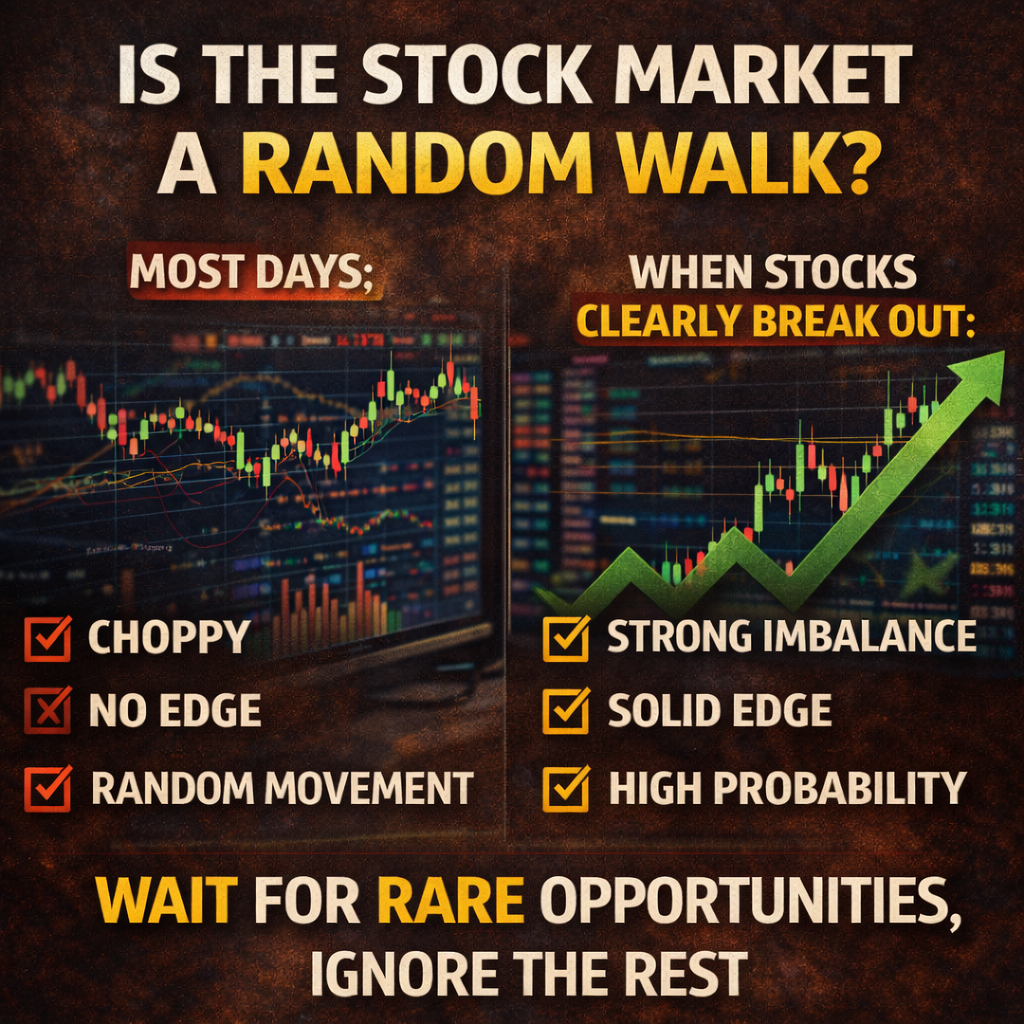
If you look at most charts on most days, what do you see?
Back and forth movement.
Choppy action.
No real conviction.
No real edge.
That is randomness. That is the market moving without a clear imbalance between buyers and sellers. If you try to force trades in that environment, you are essentially guessing. And over time, guessing leads to losses.
Many traders fail because they assume every chart is tradable. They believe opportunity is always present. It is not.
Most of the time, the market is just noise.
Where the Real Edge Exists
The real opportunity comes from recognizing when a chart is not behaving randomly.
Every once in a while, a chart will stand out. It will move in a way that clearly shows institutional activity. Strong accumulation. Strong distribution. Unusual volume. Powerful reactions to news or gaps.
When that happens, the chart stops being random.
It starts telling a story.
You will see stocks that simply cannot go down. Every dip gets bought. Or stocks that cannot bounce. Every rally gets sold. These are moments when supply and demand are clearly out of balance.
That is where the edge lives.
Your job as a trader is not to trade everything. Your job is to find those charts that clearly show intention. The ones that practically announce that buyers or sellers are in control.
Those are the trades worth focusing on.
Why Patience Matters So Much
If most of the market is random most of the time, what does that mean for you?
It means patience is not optional. It is essential.
You must be willing to sit through long stretches of nothing. You must be willing to ignore mediocre setups. You must be willing to wait until something truly stands out.
This is especially true if you only trade one instrument, like a futures contract. When you only have one chart to watch, you are forced to wait for that single chart to show opportunity. Sometimes that takes time.
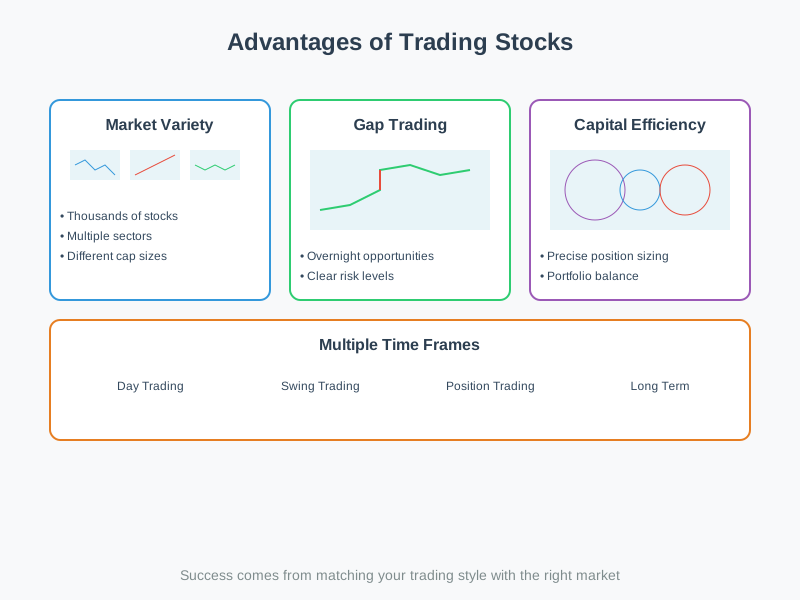
With stocks, you can scan hundreds of charts and find the few that clearly break away from randomness. That is why variety creates opportunity.
Trading Is About Finding the Exception
The biggest mistake traders make is assuming the market is always offering opportunity. It is not. Most of the time, price action is random and untradable.
But occasionally, you will find charts that break that pattern. Charts that show clear strength. Clear weakness. Clear institutional involvement.
Those moments are not random.
Those moments are where money is made.
The goal is simple.
Accept that randomness is the norm.
Wait for the exceptions.
Trade those aggressively but intelligently.
Great trading is not about predicting every move.
It is about recognizing when the market stops behaving randomly and starts behaving predictably enough to give you an edge.