

Hello Live Traders family,
There has been a lot of buzz recently about the Pattern Day Trader rule, also known as the PDT rule, and what the recent changes mean for traders.
So I want to break this down for you in simple language, explain what actually changed, and more importantly, explain what did not change.
Because while the barrier to entry into day trading is getting lower, the risk has not changed at all.
And that is where most traders get into trouble.
What Actually Changed
On April 14, 2026, the SEC approved FINRA’s rule change related to the Pattern Day Trader framework.
FINRA followed that approval with Regulatory Notice 26 10, which outlined the implementation timeline.
The new rule is scheduled to become effective on June 4, 2026.
However, and this is important, that does not mean every broker will switch to the new system on that exact day.
Brokerage firms are allowed to phase in the changes gradually, and the full transition period extends all the way until October 20, 2027.
So while the rule is changing, the rollout will not happen overnight.
Each broker will implement the changes at its own pace.
What This Means in Plain English
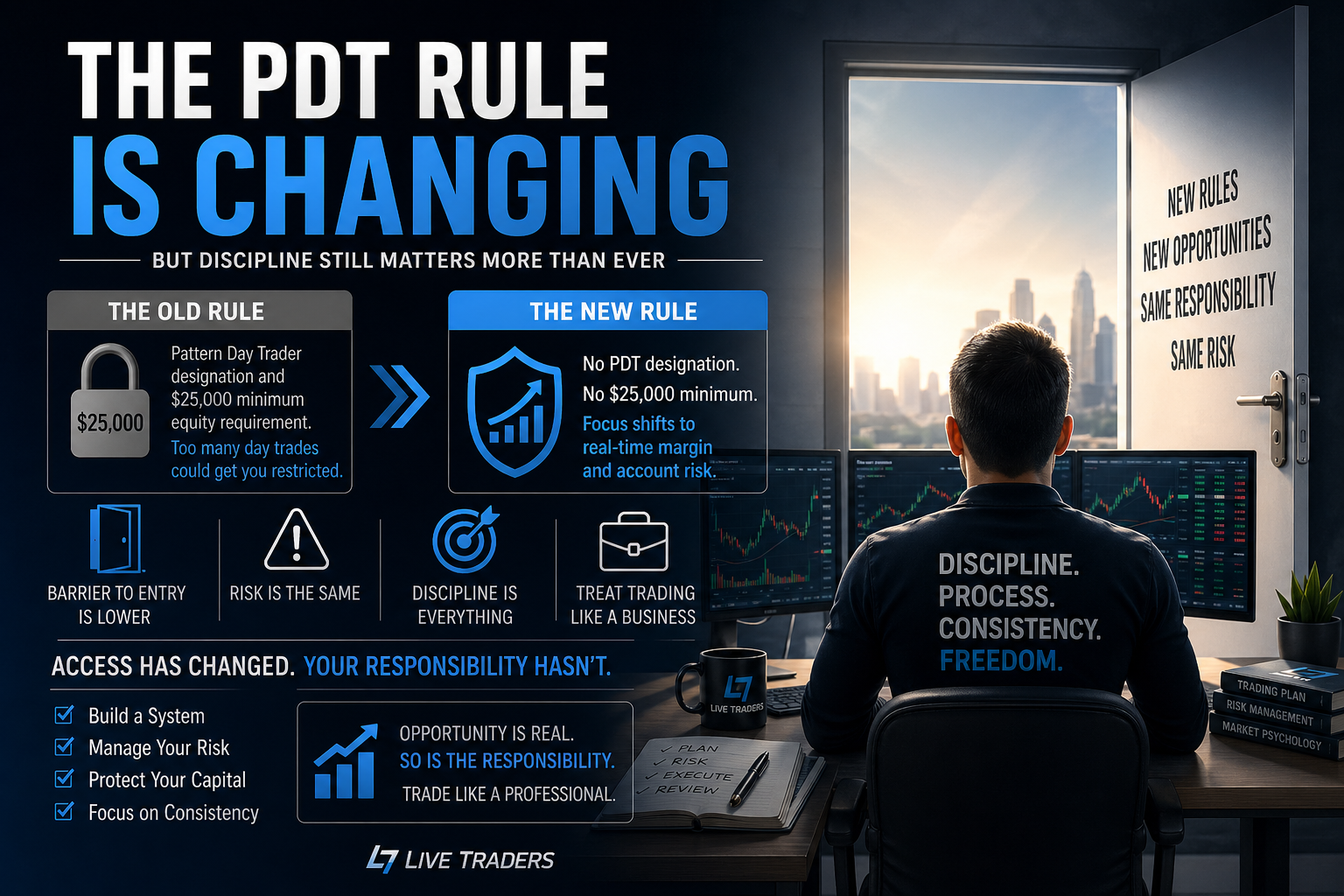
Under the old system, if you made too many day trades in a margin account with less than twenty five thousand dollars, you could be labeled a Pattern Day Trader and restricted from trading.
That framework is now being replaced.
The new approach removes the old Pattern Day Trader designation and removes the fixed twenty five thousand dollar minimum equity requirement.
Instead of focusing on a specific dollar amount, the new system focuses on real time risk and margin.
In simple terms, the question is no longer:
Do you have twenty five thousand dollars
The question is now:
Does your account have enough capital and margin support for the trades you are taking right now
That is a very different way of thinking about risk.
The Important Catch
This change does not mean restrictions magically disappear.
Even after the new rule becomes effective, brokers can still impose their own risk controls, margin requirements, and trading limitations.
And many of them will.
Every brokerage firm has its own systems, policies, and risk management procedures. Some will implement the changes quickly. Others will take more time.
So if this rule matters to you, do not assume your broker will change immediately.
Check directly with them.
The Real Opportunity
For smaller accounts, this is a meaningful development.
For years, the PDT rule created a psychological and logistical barrier that limited how often traders could practice, execute, and gain experience.
That barrier is now being lowered.
But lowering the barrier to entry does not lower the risk.
Let me say that again.
The barrier to entry is getting lower
The risk is staying exactly the same
And that is where mindset becomes everything.
Trading Is a Business
Not a Game
One of the biggest mistakes new traders make is assuming that access equals success.
They think:
If I can trade more often
I will make more money
But that is not how this works.
If you run a restaurant, you do not succeed just because you are allowed to open your doors.
You succeed because you have a system.
A process.
A plan.
A repeatable method.
Trading is no different.
The moment you start treating trading like a business, everything changes.
You track your performance.
You manage your risk.
You follow your rules.
You focus on consistency, not excitement.
That is the difference between professionals and gamblers.
The 60 Second Truth About Trading
Here is the message I want every trader to understand.
You can make money once without a system.
That is luck.
But if you want to make money consistently, you need a repeatable process.
A system is replicable.
A system is measurable.
A system is scalable.
Luck is none of those things.
And this new rule change makes that reality even more important.
Because more access without discipline leads to faster losses.
The Risk Has Not Changed
Whether you have five thousand dollars
Ten thousand dollars
Or one hundred thousand dollars
The market does not care.
Every trade still carries risk.
Every decision still requires discipline.
Every mistake still costs money.
Removing the PDT rule does not remove risk.
It removes a restriction.
And that means responsibility shifts even more onto the trader.
What Smart Traders Should Do Right Now
If you are serious about trading, here is how to approach this change.
Stay informed about your broker’s rollout timeline
Understand your margin requirements and risk limits
Focus on building a consistent system
Treat your account like a business, not a lottery ticket
And most importantly
Protect your capital
Because capital is your inventory in this business.
Without inventory, there is no business.
The Bottom Line
This is a major change in the trading world.
The barrier to entry is coming down.
But success in trading has never depended on access.
It has always depended on discipline.
So do not celebrate the removal of the rule.
Prepare for the responsibility that comes with it.
Trade with a plan.
Manage your risk.
Execute your system.
And play the game like a professional.