Hey traders,
We’ve all been there. You close out a solid week in the markets, and the first thing you want to do is log everything — entries, exits, stop placements, trade management, the full picture. So you fire up that sleek cloud journaling app everyone’s raving about. Beautiful dashboards. Automated stats. One-click broker imports. Sync across all your devices. It feels professional. Modern. Necessary.
But before you upload another trade, I want you to sit with one question:
Who controls that data?
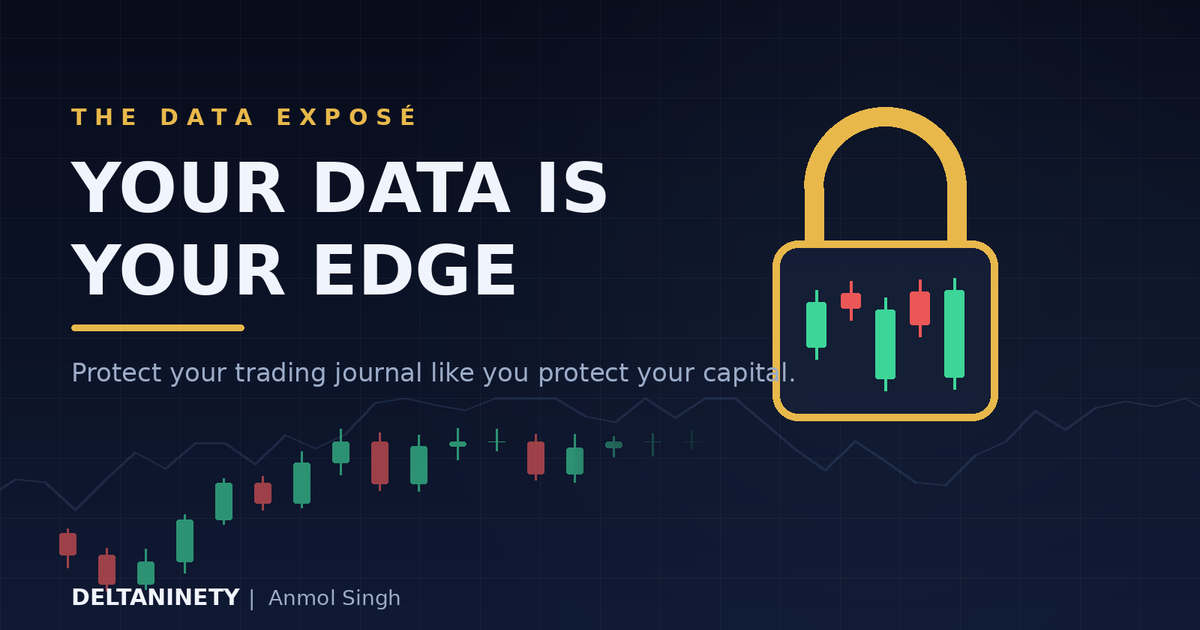
Every trader worries about protecting their edge. We protect our watchlists. We protect our scanners. We protect our strategies and our position sizing models. And yet there’s one asset many traders hand over without a second thought: their complete trading history.
Thousands of trades. Years of experience. Every entry. Every exit. Every stop loss. Every target. Every adjustment. Every mistake. Every lesson.
The question isn’t whether this information has value. It absolutely does. The question is whether you’ve really thought about where it lives — and whose incentives govern it.
But what if I told you that the very tool designed to help you improve is quietly doing the opposite over time — especially if you’re already profitable? What if the convenience comes with a hidden price tag that’s far more expensive than the monthly subscription? This isn’t some tinfoil-hat rant. It’s a pattern that’s becoming impossible to ignore, backed by how data flows in modern markets, the explosion of AI in finance, and basic incentives that drive these companies. Let’s pull back the curtain on cloud-based trading journals and trackers. The ones that promise the world while holding your entire trading history hostage on their servers.
Your Trading Journal Is Intellectual Property
If you’ve spent years becoming consistently profitable, your trading journal isn’t just a diary. It’s the blueprint of how you think. It represents thousands of hours of screen time, countless losses, real money at risk, and hard-won pattern recognition that can’t simply be downloaded from the internet.
A professional chef protects recipes. A hedge fund protects research. A software company protects source code. No prop firm on earth would upload its playbook to a third-party server and just trust that everything works out.
So why do so many serious traders do exactly that — casually, monthly, for the price of a subscription?
The Convenience Is Real. So Is the Trade-Off.
Let’s be fair: cloud journaling software is genuinely convenient. Everything syncs automatically. You can log in from anywhere. Reports generate instantly. Backups happen without you thinking about it. Those are real advantages, and for many traders they’re worth it.
But convenience means placing your information on infrastructure you don’t own. Your data isn’t living on your hard drive — it’s sitting on someone else’s servers, governed by someone else’s terms of service, subject to someone else’s business decisions.
That isn’t inherently sinister. But it requires trust. And here’s the uncomfortable part: most traders have never read the documents that define exactly what they’re trusting these companies to do.
Go pull up the terms of service and privacy policy of whatever platform holds your trading history. Read them carefully. Look for the language around aggregated data, anonymized data, derivative works, and the rights you grant the company by uploading your information. Look at what happens to those rights if the company is acquired. Look at whether “we will never sell your personal data” quietly excludes aggregated or de-identified data — which, for trading behavior, is precisely the data that matters.
Too few traders ever do this. Do it this week.
The AI Era Changes the Math
Here’s why this question matters more now than it did five years ago.
We’re living through a period where data has become one of the most valuable commodities on Earth. Every major technology company is pouring money into artificial intelligence, and machine learning systems improve when they’re fed larger, higher-quality datasets. That’s not a conspiracy theory — that’s simply the economics of AI.
Now think about what a trading journal actually contains. It isn’t merely a record of the past. It’s structured behavioral data: where a real trader with real money placed stops, took profits, scaled in, scaled out, held through drawdowns, and cut losers. It reveals decision-making, risk tolerance, execution habits, and trade management — tagged, timestamped, and organized.
In the old days, this information was fragmented. A private Excel sheet here, a notebook there. Nobody had the full picture. Centralized cloud platforms changed that. For the first time, complete behavioral histories from thousands of traders sit in single databases — clean, structured, and machine-readable. Think about it. Profitable traders are gold. Retail data from thousands (or millions) of accounts gives an unprecedented map of where real money clusters: liquidity pools, stop clusters, common psychological exit points. In the old days, this information was fragmented — a bunch of private Excel sheets here, a local database there. Not anymore. Centralized cloud platforms changed everything. The theory — and there’s mounting circumstantial evidence in market behavior — is straightforward:
1. Training AI Models on Your Edge: Your winning setups are being fed into machine learning systems. Not just basic stats, but granular patterns: “When this trader sees XYZ setup on the 5-minute chart with these indicators, they place stops 1.5% below the swing low and target 3R.” Scale that across thousands of profitable users, and you have an incredibly rich training set. These firms (or the bigger players they partner with) get to build sophisticated predictive models without risking their own capital. They learn from your wins and losses. 2. Selling or Sharing the Data: Market makers, high-frequency trading (HFT) firms, and prop shops are starving for this kind of alpha. Where do retail stops tend to cluster? Where’s the liquidity that can be harvested? Which patterns do consistent traders follow? Your journal data paints a frighteningly accurate picture. Even anonymized aggregates can reveal exploitable edges when combined with order flow and other feeds. This isn’t entirely new — brokers and data providers have sold aggregated info for years. But the depth and specificity from personal journals is on another level. And with AI, the ability to act on it in real-time has exploded.
Whether today or ten years from now, datasets like that will only become more valuable. And here’s the incentive question every serious trader should ask:
A firm could spend millions building and backtesting models on simulated data. Or a dataset could exist where thousands of real traders have already done the work — logging real decisions, with real money, in real market conditions, day after day. Which one do you think is worth more? These companies aren’t charities. They’re data businesses disguised as trading tools. Every trade you log — every stop-loss level, every target, every entry trigger, every time you scale out or hold through volatility — becomes part of a massive, ever-growing dataset
I’m not claiming any specific company is selling your trades to market makers today. I don’t know that, and neither do you. That’s exactly the point: you don’t know, and you have no way to verify it. What you can know is what the terms of service permit, what the data would be worth, and how incentives tend to play out over time.
Think Beyond Today’s Features
Many traders only evaluate today’s product. Few think about tomorrow’s incentives.
Businesses evolve. Startups get acquired. Founders with good intentions sell to buyers with different ones. Privacy policies get updated — usually with an email nobody reads. The friendly analytics platform of today could look very different in a decade, and whoever owns that database then inherits everything you’ve ever uploaded.
Once your most valuable information lives somewhere else, you are permanently dependent on someone else’s policies, someone else’s infrastructure, and someone else’s long-term incentives. Even setting aside intent entirely — fintech platforms get breached like everything else. A complete map of your account size, performance, and trading behavior is sensitive information, full stop.
Your subscription fee keeps the lights on. The dataset is the asset.
The Slow Erosion of Your Results
Have you noticed any of these lately? • You get stopped out on a trade, only for price to reverse and hit your original target shortly after. Classic stop hunt. • The market teases your profit target but reverses just before you exit, forcing you to watch it run without you. • Increasing slippage on entries or exits, even in supposedly liquid conditions. • Setups that used to work with high probability suddenly feel “off” — filled poorly or fading right after entry. One or two instances? Coincidence. A pattern over months? That’s when you start questioning your edge. The sinister part? It’s gradual. Your results don’t collapse overnight. They bleed. The platforms keep you hooked with nice charts and “insights” while the data you feed them sharpens the tools being used against you. Profitable traders provide the cleanest signal. Novices? Their random noise is less valuable. That’s why these tools often start cheap or with trials — they want volume, especially from those who stick around and build serious histories. Bigger accounts and consistent performers? You’re the prime target. Your data is worth real money to the right buyer.
What I Do Instead
My philosophy is simple: own your work, own your research, own your history, own your edge.
For anyone trading real size or real consistency, here’s the practical playbook:
Go local. Use journaling software that stores everything on your own machine, where nothing leaves your computer unless you explicitly choose to export it. Tools like TraderFlow are built exactly this way — you get the modern analytics and dashboards without surrendering custody of your data. Your journal, your machine, your fortress.
Or go old-school with Excel. Battle-tested, infinitely customizable, and 100% private. Yes, it takes more discipline. Protecting your edge is worth the effort.
If you truly need cloud access, use a general-purpose tool like Google Sheets. It’s not perfect, but a generic spreadsheet platform is a very different proposition from a specialized service whose entire product category is aggregating trader behavior.
And if you stay on a cloud journaling platform anyway — that’s a legitimate choice, but make it with your eyes open. Export your complete history regularly. Know exactly what the terms grant. Re-read the policy after any acquisition or “exciting news” announcement.
The Questions Every Trader Should Ask
Before you trust any platform with years of your trading history, get clear answers to these:
Who owns the data once it’s uploaded? What rights do the terms of service grant to aggregated or anonymized versions of it? Can you export everything, in a usable format, anytime? Can you delete everything — actually delete it, not just deactivate your account? What happens to your data if the company is acquired? And how might advances in AI change the value of a dataset like yours over the next ten years?
If a platform can’t give you straight answers, that tells you something too.
Think About the Incentives A firm could spend millions developing and backtesting their own models with simulated data. Or… they could let thousands of ambitious traders do the heavy lifting for them, logging real-market decisions day after day. Which sounds cheaper and more effective? This is why you see the push for “AI features” and seamless broker integrations. More data in = better models out. Your subscription fee is just table stakes. The real value is the dataset. I’m not saying every single developer has malicious intent. Many probably start with good ideas. But once the data starts flowing and the acquisition offers or partnership deals appear, principles have a way of bending. Data is the new oil — and in trading, it’s rocket fuel.
The Bottom Line
If you’re a small retail trader putting a few hundred bucks to work, this probably doesn’t move the needle for you — use whatever keeps you consistent. But if you’re serious — scaling an account, trading for a living, refining a genuine edge — then your data deserves the same discipline you apply to your capital.
You manage risk on every position you take. You size carefully, you define your downside, you never hand the market free money. Apply that exact mindset to one of the most valuable assets you’ll ever build: the record of how you trade.
Your edge is hard-won. Don’t hand it over on a silver platter — not for convenience, not for pretty dashboards, not for a $30-a-month subscription.
Audit where your trade history lives. Read what you’ve agreed to. And keep your playbook where it belongs: under your control.
What did you find when you actually read your platform’s terms of service? Drop a comment below — I’d genuinely like to hear it. And if you’re looking for a truly private way to journal and analyze your trading, check out the resources on the site, including local-first options that put you back in the driver’s seat.
Trade Safe.