One of the biggest mistakes newer traders make is assuming that the trader with the highest R multiple is automatically the better trader.
You’ll often hear traders say things like:
“I made 20R this month.”
“I made 40R this quarter.”
“I know someone who made 60R.”
While there is nothing wrong with tracking R multiples, many traders become obsessed with the number without understanding what it actually represents.
Professional trading is much more nuanced than simply chasing bigger R numbers.
In fact, some of the most important factors in trading cannot be measured by R alone.
What Is R?
For those unfamiliar with the term, R represents your initial risk.
If you risk $100 and make $200, you made 2R.
If you risk $100 and lose $100, you lost 1R.
Tracking performance in R is useful because it standardizes results regardless of account size.
But the problem begins when traders assume that R is the only thing that matters.
The Scalability Problem
The first question every trader should ask is:
Can these results scale?
A trader risking $100 per trade can often do things that become much more difficult when risking $1,000 or $5,000 per trade.
As position sizes increase, new challenges emerge:
- Liquidity becomes more important
- Slippage becomes more significant
- Trade execution becomes harder
- Psychological pressure increases
- Drawdowns become more painful
The trade that looks perfect on a small account may not produce the same results on a larger account.
This is why professional traders spend far more time thinking about scalability than most newer traders realize.
Bigger Accounts Create Different Problems
Many traders assume that increasing account size simply means making more money.
In reality, larger size changes the entire game.
A trader risking $100 per trade can lose five trades and be down $500.
A trader risking $1,000 per trade can lose the exact same five trades and be down $5,000.
The setups may be identical.
The R multiples may be identical.
The emotional experience is not.
As position size grows, fear, hesitation, patience, discipline, and confidence all become increasingly important.
This is one of the reasons many traders perform exceptionally well on small accounts but struggle when they attempt to scale.
Trading Is Capital Allocation
Most beginners think their job is to find trades.
Professional traders think differently.
Professional traders allocate capital.
That capital can be allocated to:
- Day trades
- Swing trades
- Long-term investments
- Options positions
- Covered calls
- Cash reserves
The goal is not to maximize activity.
The goal is to maximize risk-adjusted returns.
A professional trader is constantly asking:
“Where is the best opportunity for my capital right now?”
Sometimes that answer is a day trade.
Sometimes it is a swing trade.
Sometimes it is a covered call.
Sometimes the answer is no trade at all.
The Market Doesn’t Care Where Your Profits Came From
Many traders become overly attached to one strategy.
They want all of their profits to come from day trading.
But the market doesn’t care.
Your brokerage account doesn’t care.
Your bank account doesn’t care.
A dollar earned from a day trade is worth the same as a dollar earned from a covered call.
Let’s say one trader generates more R from day trading.
Great.
But another trader generates slightly less R from day trading and also earns thousands of dollars from a covered call position.
Who made more money?
Who managed capital more effectively?
Who generated the better overall return?
These are the questions professional traders ask.
The goal is not to win a day-trading competition.
The goal is to grow your account.
Win Rate Matters Too
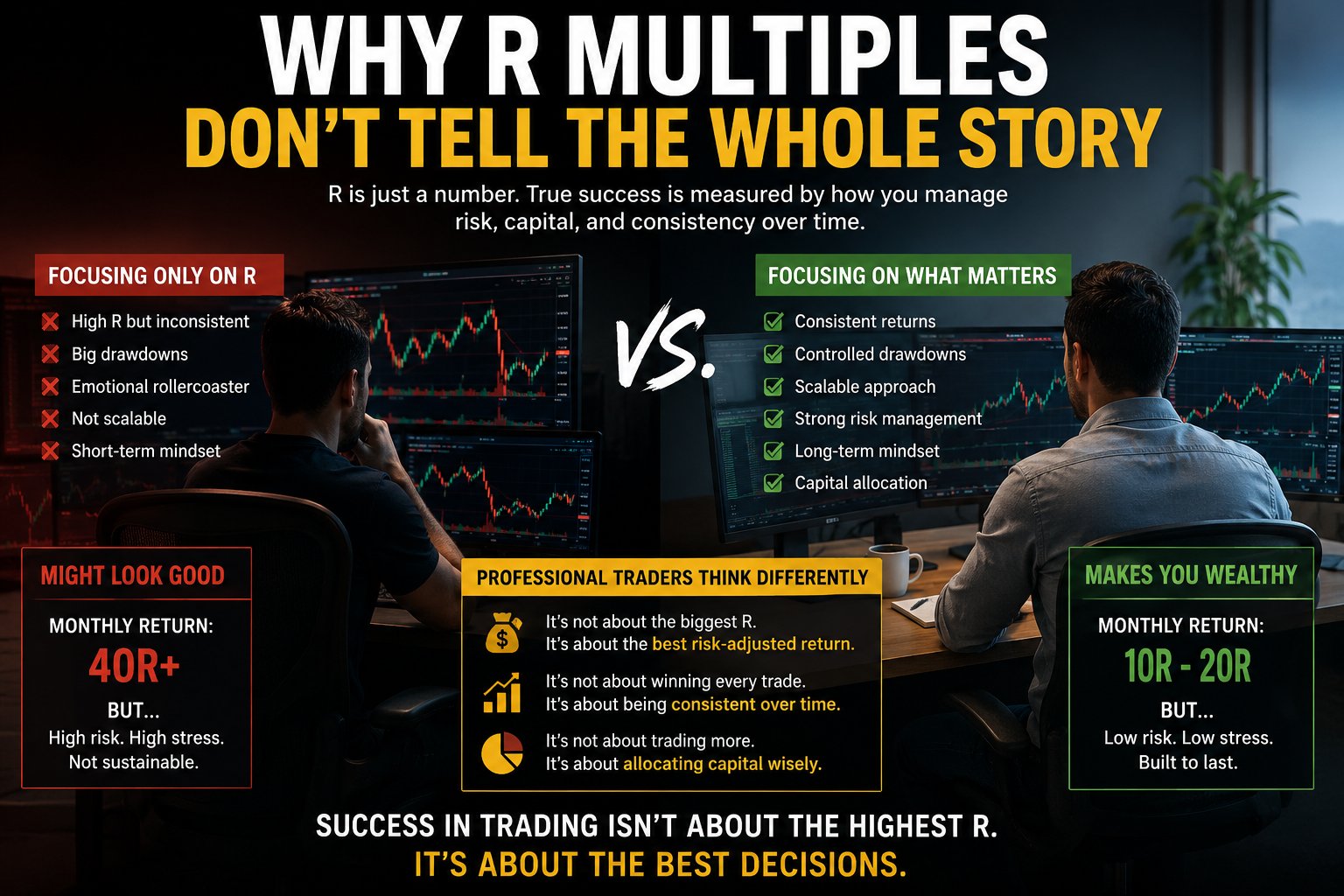
Another common mistake is focusing exclusively on total R while ignoring consistency.
Imagine two traders.
Trader A makes 20R with a 50% win rate and experiences significant drawdowns.
Trader B makes 15R with an 80% win rate and a much smoother equity curve.
Which trader is better?
The answer depends on your goals.
Many traders would gladly sacrifice some upside in exchange for:
- More consistency
- Smaller drawdowns
- Better emotional control
- Greater confidence
- Improved quality of life
Trading is not only about maximizing returns.
It is also about creating a process that you can execute month after month.
The Goal Is Sustainable Growth
Many traders chase excitement.
They chase action.
They chase large R numbers.
But professional trading is not about creating the most impressive screenshot.
Professional trading is about building a repeatable process that can survive over time.
A good month means very little if it cannot be repeated.
The traders who last are not necessarily the ones with the highest R multiples.
They are the traders who:
- Protect capital
- Manage risk
- Control emotions
- Allocate capital effectively
- Adapt as size increases
- Produce consistent returns
At the end of the month, don’t just ask:
“How many R did I make?”
Ask better questions.
Did I follow my process?
Did I manage risk properly?
Did I allocate capital intelligently?
Did my account grow?
Can I repeat these results next month?
Those are the questions that separate traders from professionals.