
The Trade Everyone Wants and Why It Usually Ends Badly
If there is one trade that seems to attract traders more than any other, it is the breakout.
A stock has been moving sideways.
Resistance is clearly visible.
Price begins pushing higher.
Volume starts increasing.
Excitement builds.
Then it happens.
The stock breaks above resistance.
Traders rush in.
Social media starts talking about it.
Financial media notices it.
Momentum traders pile in.
The stock moves a little higher.
Then something strange happens.
It stalls.
It pulls back.
It falls below the breakout level.
And suddenly all those excited buyers are trapped.
The trade that looked so obvious begins turning into a loss.
If you’ve traded long enough, you’ve experienced this.
Maybe dozens of times.
The question is:
Why does it happen so often?
The answer reveals one of the most important truths in trading.
Most traders buy exactly where they should be patient.
The Psychology Behind Breakouts
Let’s be honest.
Breakouts are exciting.
They feel powerful.
They feel aggressive.
They feel like something important is happening.
Most importantly, they feel safe.
That sounds strange because breakouts often fail.
But psychologically they feel safe because everyone can see them.
The resistance level is obvious.
The move is visible.
The stock appears strong.
The crowd agrees.
Humans naturally seek confirmation.
A breakout provides it.
The problem is that the market often exploits exactly this behavior.
Why Traders Love Confirmation
Think about what happens emotionally during a breakout.
The stock has already moved higher.
The chart looks strong.
The news may be positive.
Other traders are talking about it.
Everything appears aligned.
At that moment, buying feels comfortable.
Unfortunately, comfort is not always profitable.
The market often rewards those who act before confirmation becomes obvious.
By the time everyone agrees, much of the edge has disappeared.
The breakout becomes crowded.
And crowded trades often create problems.
The Supply and Demand Problem
To understand why many breakouts fail, you need to understand something simple.
Every rally eventually encounters sellers.
Imagine a stock that has traded below a resistance level for several months.
Hundreds of traders bought near that resistance level.
Many of them watched the stock decline.
They have been holding losing positions.
Now price finally returns to their entry point.
What are they thinking?
Many are thinking exactly the same thing:
“Thank goodness. I can finally get out.”
As price reaches resistance, these traders begin selling.
Their selling creates supply.
That supply often overwhelms the new buyers chasing the breakout.
The result?
The stock stalls.
The breakout fails.
Why Markets Love Mean Reversion
One of the biggest misconceptions among newer traders is believing that stocks are always trending.
They are not.
In reality, most markets spend most of their time oscillating.
Prices rise.
Prices fall.
Prices return toward average.
This process is called mean reversion.
And it happens far more often than most traders realize.
The majority of ordinary stocks spend most of their lives moving within ranges.
The majority of ordinary moves eventually retrace.
The majority of ordinary breakouts eventually fail.
This does not mean breakouts never work.
It means they are often overused.
The Difference Between a Good Breakout and a Bad Breakout
This is where many traders become confused.
If most breakouts fail, should we avoid them entirely?
Absolutely not.
Some of the biggest moves in market history began as breakouts.
The key is understanding that not all breakouts are created equal.
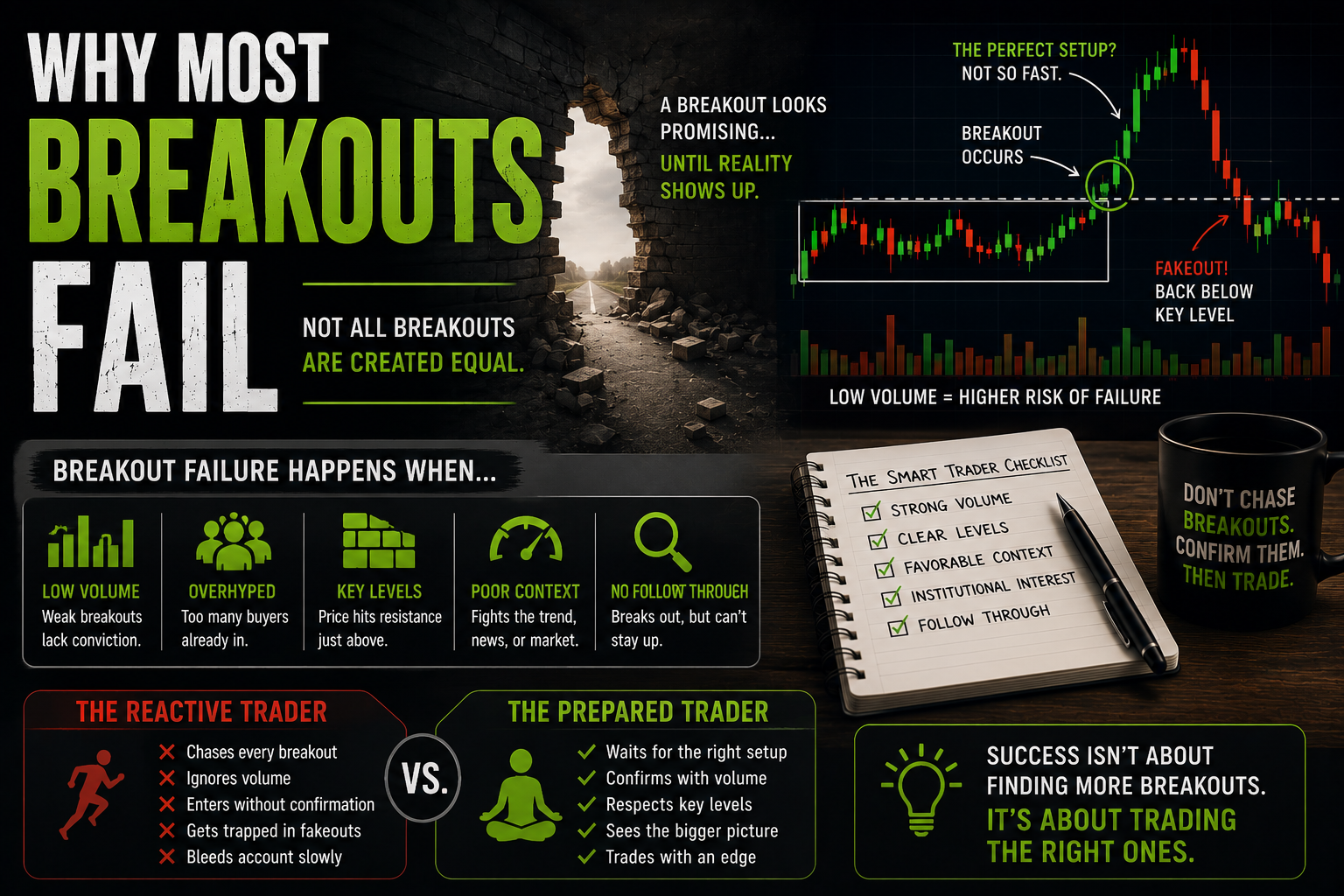
A bad breakout often has several characteristics:
It is obvious.
It occurs after an extended move.
It lacks institutional accumulation.
It attracts excessive attention.
It occurs without a strong catalyst.
It happens in a weak overall market.
A good breakout often looks very different.
It emerges from genuine accumulation.
It occurs after strong consolidation.
It shows relative strength.
Volume expands significantly.
Institutional buying is evident.
The market environment supports higher prices.
The difference is not always easy to see.
But it matters enormously.
The FOMO Trap
Perhaps the biggest reason traders lose money on breakouts is FOMO.
Fear of Missing Out.
Imagine watching a stock rally for several days.
You did not buy it.
Now it approaches resistance.
Suddenly it breaks higher.
You feel pressure.
The stock is moving.
Other traders are participating.
You are not.
The fear begins growing.
You convince yourself that if you don’t buy now, you’ll miss the entire move.
So you buy.
Not because you have a plan.
Not because probabilities favor you.
Because you are afraid.
Fear creates terrible decisions.
The market knows this.
And it exploits it constantly.
Why Professionals Often Buy Pullbacks
One of the biggest differences between professionals and amateurs is entry selection.
Amateurs often buy strength.
Professionals often buy weakness within strength.
That distinction is critical.
Imagine a stock in a healthy uptrend.
Instead of buying after a large move higher, professionals often wait.
They allow price to pull back.
They allow emotion to settle.
They allow weaker hands to exit.
Then they enter.
Their risk is lower.
Their reward potential is greater.
Their probability of success improves.
This is not exciting.
It is effective.
The Boring Trade
One of the greatest lessons a trader can learn is that profitable trading is often boring.
Most people do not want to hear that.
They want excitement.
They want action.
They want adrenaline.
Unfortunately, adrenaline and profitability rarely coexist.
The best trades often feel ordinary.
A stock pulls back into support.
Buyers step in.
The trend remains intact.
The stock continues higher.
Nothing dramatic happens.
No headlines appear.
No excitement exists.
Just a high probability setup executed correctly.
This is how many professionals make money.
Consistently.
Quietly.
Repeatedly.
The Casino Perspective
Imagine walking into a casino.
You see two games.
The first offers a small edge.
The second offers a large edge.
Which game should you play?
The answer seems obvious.
Yet traders routinely do the opposite.
They choose excitement over edge.
They choose action over probability.
They choose entertainment over profitability.
The market rewards those willing to choose differently.
What a Failed Breakout Teaches You
Failed breakouts are not just losses.
They are information.
A failed breakout often reveals something important.
It tells you demand was insufficient.
It tells you sellers were stronger than expected.
It tells you the market was not ready.
Professional traders pay attention to these clues.
Many powerful short opportunities actually begin as failed breakouts.
Why?
Because trapped buyers become future sellers.
As price falls, those buyers begin exiting.
Their selling adds fuel to the decline.
What looked bullish suddenly becomes bearish.
Again, the market is providing information.
The key is listening.
The Importance of Context
One reason many traders struggle with breakouts is that they ignore context.
No setup exists in isolation.
Every breakout occurs within a larger environment.
Questions matter.
Is the overall market strong?
Is the stock showing relative strength?
Is volume supporting the move?
Has institutional accumulation been present?
Has the stock already made a large move?
Is the breakout occurring from a proper base?
Without context, a breakout is simply a line on a chart.
With context, it becomes a decision.
Why Patience Wins
Most trading mistakes can be traced back to impatience.
The desire to act.
The desire to participate.
The desire to force opportunity.
Patience allows you to wait for better entries.
Patience allows you to avoid crowded trades.
Patience allows you to let the market reveal information.
Patience is not passive.
Patience is strategic.
Professional traders understand that waiting is often part of the trade.
A Different Way to Think About Breakouts
Instead of asking:
“Should I buy this breakout?”
Try asking:
“What makes this breakout different?”
What evidence exists that institutions are involved?
What evidence exists that demand is increasing?
What evidence exists that this move is more than ordinary noise?
Those questions shift your focus.
They force you to think probabilistically.
They force you to become selective.
And selectivity is one of the greatest advantages a trader can develop.
Final Thoughts
Most breakouts fail because most breakouts are ordinary.
They attract attention.
They attract emotion.
They attract FOMO.
But they lack the characteristics necessary to sustain a meaningful move.
The market is not interested in rewarding excitement.
The market rewards probabilities.
The best traders understand this.
They do not chase every breakout.
They do not buy because everyone else is buying.
They do not confuse activity with opportunity.
Instead, they wait.
They observe.
They look for evidence.
They focus on context.
Most importantly, they understand that profitable trading is often far less exciting than people imagine.
The trader who learns to embrace boring, high probability setups gains an enormous advantage.
Because while everyone else is chasing the move, the professional is patiently waiting for the opportunity.
And more often than not, patience wins.